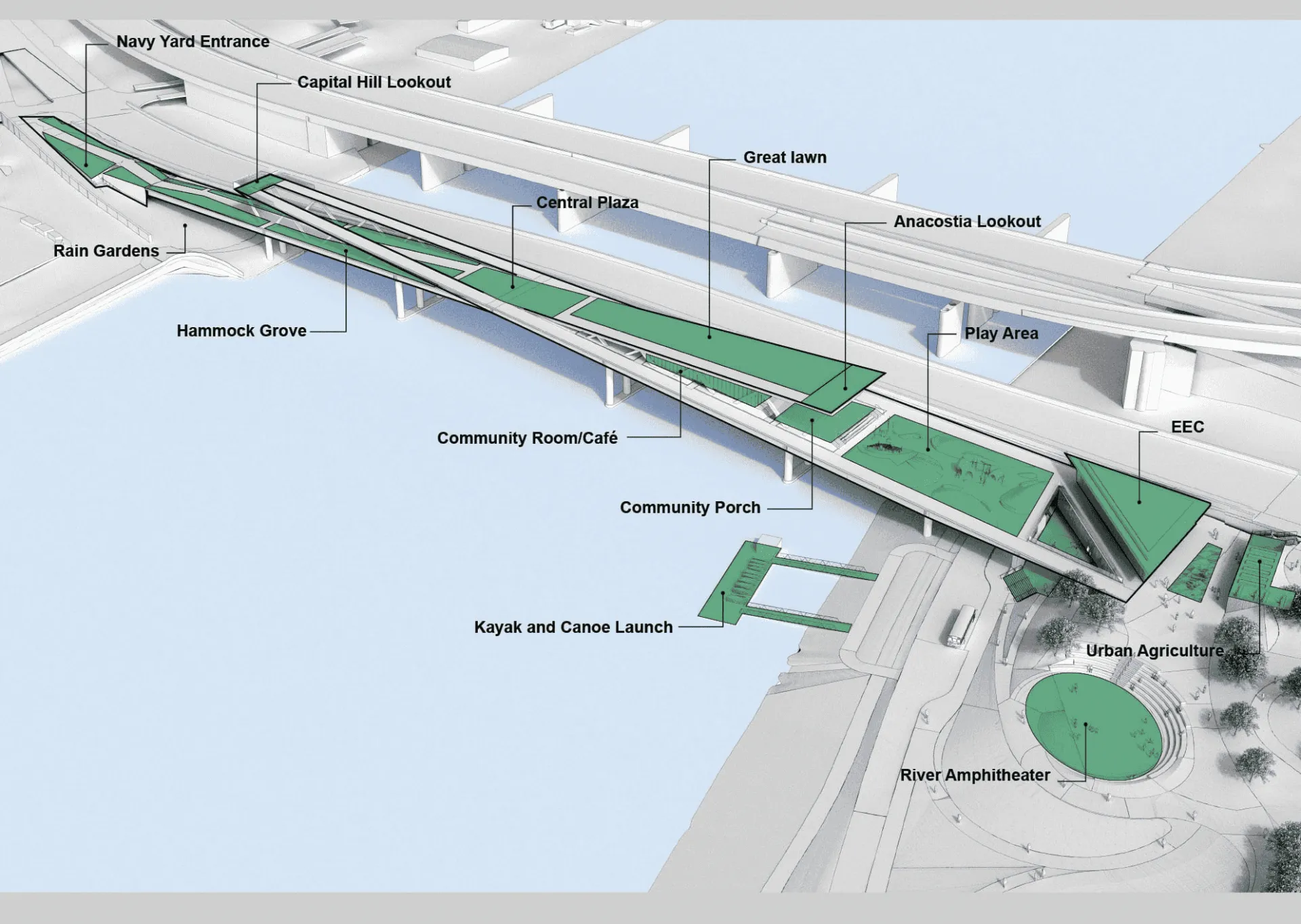
11th Street Bridge Washington D.C
This case study transforms a former freeway bridge into a community-driven public space that reconnects the neighborhoods of Anacostia and Capitol Hill, bridging long-standing social, economic, and physical divides.
Features of the Project
- Outdoor Performance & gathering spaces
- Urban Agriculture and classrooms for environmental education
- Public Art honoring regional & community History
- Kayak & paddle boat access to the river
- Kiosk food services featuring local small businesses
History
Capitol Hill and Anacostia are two distinct communities shaped by Washington D.C.’s long history of displacement and inequality. Capitol Hill, founded in 1790, has consistently housed wealthy white residents. Its proximity to the Capitol and the Navy Yard fostered a neighborhood of single-family homes and small businesses serving government and industrial workers. Anacostia, once called Uniontown, began as a white working-class area with exclusionary contracts barring African and Irish Americans. In 1877, Frederick Douglass settled nearby, laying a foundation that later attracted African American families during the Great Migration. By the mid-20th century, African Americans were concentrated east of the river, attracted by strong civic networks and integrated schools, but pushed into segregated public housing by city policies. Today, Anacostia is 97% Black, with a poverty rate more than twice the city average, and over 40% of residents are rent burdened. The 11th Street Bridge Park aims to connect these distinctly different communities; thus, its success hinges on doing so without displacing Anacostia’s long-standing residents.
Development of the Project
With a vacant unused bridge began stemming from the director of the Department of Transportation, Harriet Tregoning. After telling the idea to her friend Scott Kratz, who was the then vice president of Education at the National Building Museum, he jumped on the idea. Kratz is the director of the 11th Street Bridge Park. Kratz attended over 200 community meetings to see if there was interest. After speaking to civic associations, ANCs (advisory neighborhood commissions), community leaders, church leaders , and business owners. After support, the next step was to decide who should be in charge. Kratz and Tregoning founded a non-profit organization in Anacostia, Building Bridges Across the River (BBAR). The nonprofit administers theWardd 8-based Town Hall Education Arts Recreation Campus (THEARC). BBAR was the clear choice due to their proximity to the bridge and their acknowledged experience in serving local low-income neighbors (such as the Covenant Supportive Housing Program and the National Children’s Medical Centers in DC) and promoting interactions across different income strata. Lastly, BBAR would have guaranteed to Bridge PPark an incredible fiscal basis, considering that it raised 27 million public and private dollars to build THEARC soon after its launch. With the ability to have 2 full-time staffers, the synergies were catalyzed.
They held park-design charrettes with neighborhood residents on each side of the river. A design oversight committee was formed to guide the urban design process, including stakeholders from across the city: Elizabeth Miller (National Capital Planning Commission), Mary Abe (Anacostia Watershed Society), community residents, advocates, ANC commissioners, food insecurity and arts nonprofits, green-space advocates, parks administrators, planners, and an architect. After a seven-month design competition and public meetings with four finalist teams, the Bridge Park design oversight committee and a formal jury selected to represent community groups, chose the winning team in October 2014. The urban design firm OMA and landscape architect OLIN formed the OMA+OLIN partnership, combining architectural and landscape expertise.
OMA Partner-in-Charge Jason Long described the 11th Street Bridge Park as a literal and symbolic intersection—a dynamic, multi-layered space serving both sides of the river. Designed as a gateway, lookout, canopy, and public plaza, the bridge forms an iconic “X” that reflects D.C.’s civic identity. The concept centers on creating a clear point where both sides of the river converge and coexist.
Funding
The Bridge Park has secured its full $92 million construction budget, including $15 million from a federal grant. JP Morgan Chase contributed $10 million to support Wards 7 and 8, and the D.C. government committed $8.4 million. (Hill Rag 2025) Over 1,000 stakeholder meetings shaped the project’s design and impact. The Project is projected to break ground in early 2026 and open in 2028
The Equitable Development Plan
The team understood that beautiful design wasn’t enough.
So they created one of the first Equitable Development Plans in the country, tied to the project.
This plan has three main pillars:
- Workforce Development – ensuring local residents, with a focus on Wards 6, 7, and 8, were first in line for construction and permanent jobs.
- A Community Workforce Agreement (CWA) was created to guarantee local hiring, fair wages, and training programs.
- Small Business Support – establishing kiosk-based food vendors and creating opportunities for local entrepreneurs to operate within and around the park.
- Affordable Housing – partnering with DC Housing Authority, CNHED, and others to create a Community Land Trust (CLT) that keeps homes permanently affordable.
Analysis
The Co-Cities framework is based on 5 key principles. Below, we will delve into this project's effectiveness of these principles and their implementation.
Collective Governance (Co-goverance)
The 11th Street Bridge Park shows a high level of co-governance. In fact, a non-profit utility(Building Bridges Across the River BBAR) manages the project, the DC government has theultimate ownership right on the park (DC Housing Authority and DC Office of Planning), active citizens associations (Fairlawn Citizens Association), knowledge institutions (such as theUrban Institute, the Urban Land Institute, the DC Fiscal PolicyInstitute) and universities (such asUniversity of the District of Columbia's College of Agriculture, Urban Sustainability andEnvironmental Sciences) are directly involved in meetings, task forces, planning, designcompetitions, the Anacostia Festival and volunteer activities. The project has counted about 1,000 stakeholder meetings since 2014. Moreover, private foundations not only contribute through donations to finance the park, but also influence decision-making processes through their participation in meetings and task forces. The 11th Street Bridge Park is a 501-c-3 nonprofit utility, which is the most common type among the 29 types of 501(c) nonprofit organizations in the US. In legal terms, it is a private foundation, sometimes called a non-operating foundation, and it receives most of its income from investments and endowments. This income is used to make grants to other organizations, rather than being disbursed directly for charitable activities. It aims to improve the quality of life of residents in the eastern part of the Anacostia River by providing leadership, management, and financial oversight of the Town Hall Education Arts Recreation Campus (THEARC). Inside the THEARC campus, ten of Washington, D.C.’s best nonprofit agencies reside and work collaboratively under BBAR’s leadership to provide cultural arts, social services, health care, recreation, and educational programs.
Enabling State
The state has played a strong and consistent role throughout the commoning process, acting as the project’s first sponsor. The idea for the elevated park was initially proposed to Scott Kratz, then director of the 11th Street Bridge Park and now President of BBAR, by Harriet Tregoning, former Director of City Planning, and the DC Department of Transportation. Beyond funding and grants, the state has remained actively involved in meetings, task forces, and design competitions. Its role can be seen as both collaborative and experimental in shaping the project’s development.
Social & Economic Pooling
The 11th Street Bridge Park reflects a pooling economy, rooted in co-production, solidarity, and social justice. Its main goal is to foster equitable and inclusive growth in the historic Anacostia neighborhood by reconnecting it with Capitol Hill, through affordable housing, job creation, economic development, and a safe, healthy community. The approach so far resembles a collaborative economy, where all parties engage in peer-to-peer co-design meetings. Additionally, the Equitable Development Plan aims to strengthen a communing economy. Its support for small businesses, workforce development, and affordable housing, especially through a Community Land Trust, clearly reflects this intention.
Expermentialism
The 11th Street Bridge Park offers a wide range of governance experiments. Moreover, its approach has followed a replicable method of engagement and co-design. I would argue that it should be replicated in other contexts, especially since it’s connected to similar national projects like the High Line Park in New York. However, it is specifically designed to avoid the shortcomings seen in those other examples, such as rising property values and the resulting displacement of local communities.
Tech Justice
So far, there isn’t much public info about how the 11th Street Bridge Park uses technology to support community building, inclusive decision-making, or social equity. But since the project’s core goal is equitable growth, it’s reasonable to expect that tech access, like closing the digital divide, will eventually be part of the plan. The park is meant to reconnect two neighborhoods, so breaking down barriers, including digital ones, should be part of that effort. While tech justice doesn’t seem to be a major focus yet, the hope is that as the Equitable Development Plan rolls out, it will include steps to make sure all residents can access the tools, resources, and opportunities the project provides