Design Principles
The design principles at the heart of the Co-City Framework guide cities in creating co-governance structures where all sectors can partner as equals. These principles enable cities to move from individual projects toward systematic co-governance approaches that reshape how urban challenges are addressed.
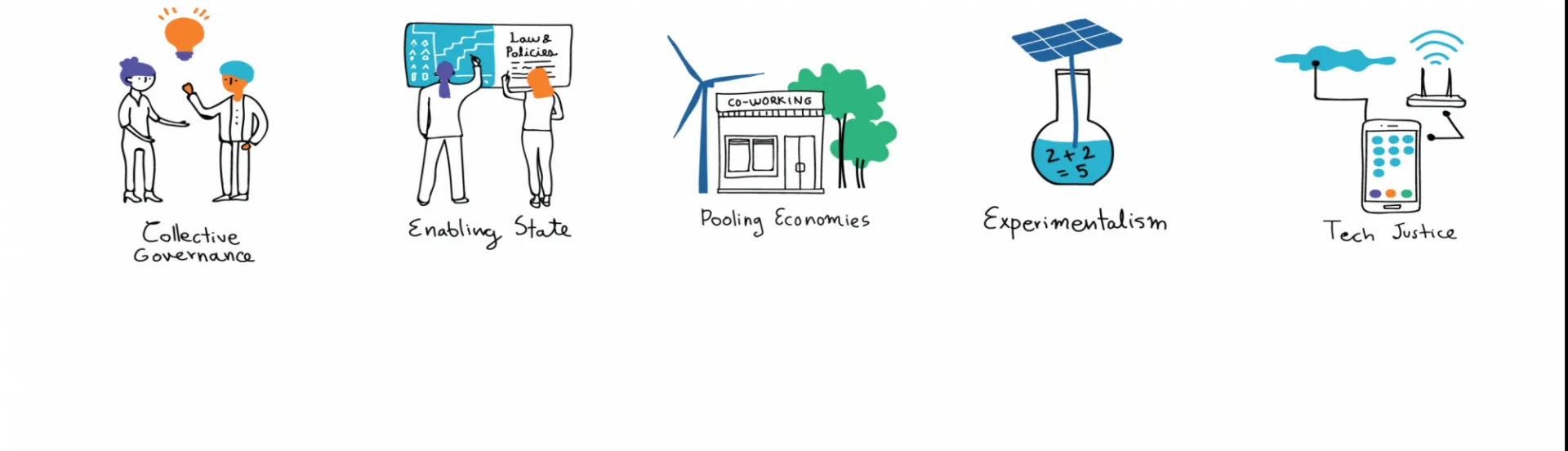
Drawing from global case studies and refined through practical applications in U.S. cities, five foundational principles define a Co-City: Collective Governance, Enabling State, Pooling Economies, Experimentalism, and Tech Justice.
Together, these principles offer a roadmap for cities to build collaborative, resilient, and community-driven environments where governance is shared, community goods are created, and equity is woven into everyday practice.
The 5 Principles

Co‑governance describes how shared urban resources, such as parks, community centers, or digital infrastructure, are managed not by a single authority but through collaborative structures. The goal is to ensure that governance is inclusive, responsive, and rooted in the community’s needs.
- Active Citizens and Local Communities. These include residents, grassroots organizers, social innovators, and city makers who initiate or participate in commons-based projects.
- Public Authorities: Local government agencies, city departments, and municipal leaders who provide regulatory support, funding, or infrastructure.
- Private Sector Actors: Businesses of all sizes, especially local enterprises and social businesses, that contribute resources, expertise, or investment.
- Civil Society Organizations and NGOs Nonprofits, advocacy groups, and community organizations that represent public interests and help coordinate efforts.
- Knowledge Institutions: Universities, research centers, and think tanks that offer data, evaluation, and strategic guidance.
When these five groups are actively involved in decision-making and resource management, co-governance becomes visible and measurable. For planners, this model offers a practical recipe: build partnerships across these sectors, create shared decision-making platforms, and design policies that enable collaboration.

Enabling State is the design principle that defines the role of public authorities in co- governance. It identifies how the state can act as a supportive platform that facilitates collective action. When the state enables rather than controls, it becomes a key factor in the success of community-led urban commons projects.

Pooling economies highlight the role of community‑run institutions that operate outside mainstream markets. These locally managed or owned initiatives use collaborative, cooperative, or circular models to create new opportunities, services, and shared benefits.

Approaches that see the city as a socio‑ecological system emphasize applied, locally grounded experimentation. They encourage multiple governance trials, direct engagement with participants, and close observation of decision‑making in practice.

Tech Justice highlights the potential of digital infrastructure and access to technology to support collaboration, local development, and social cohesion. An open digital ecosystem can spark a virtuous cycle: openness drives innovation, which attracts users and stakeholders, leading to increased investment in urban tech infrastructure.