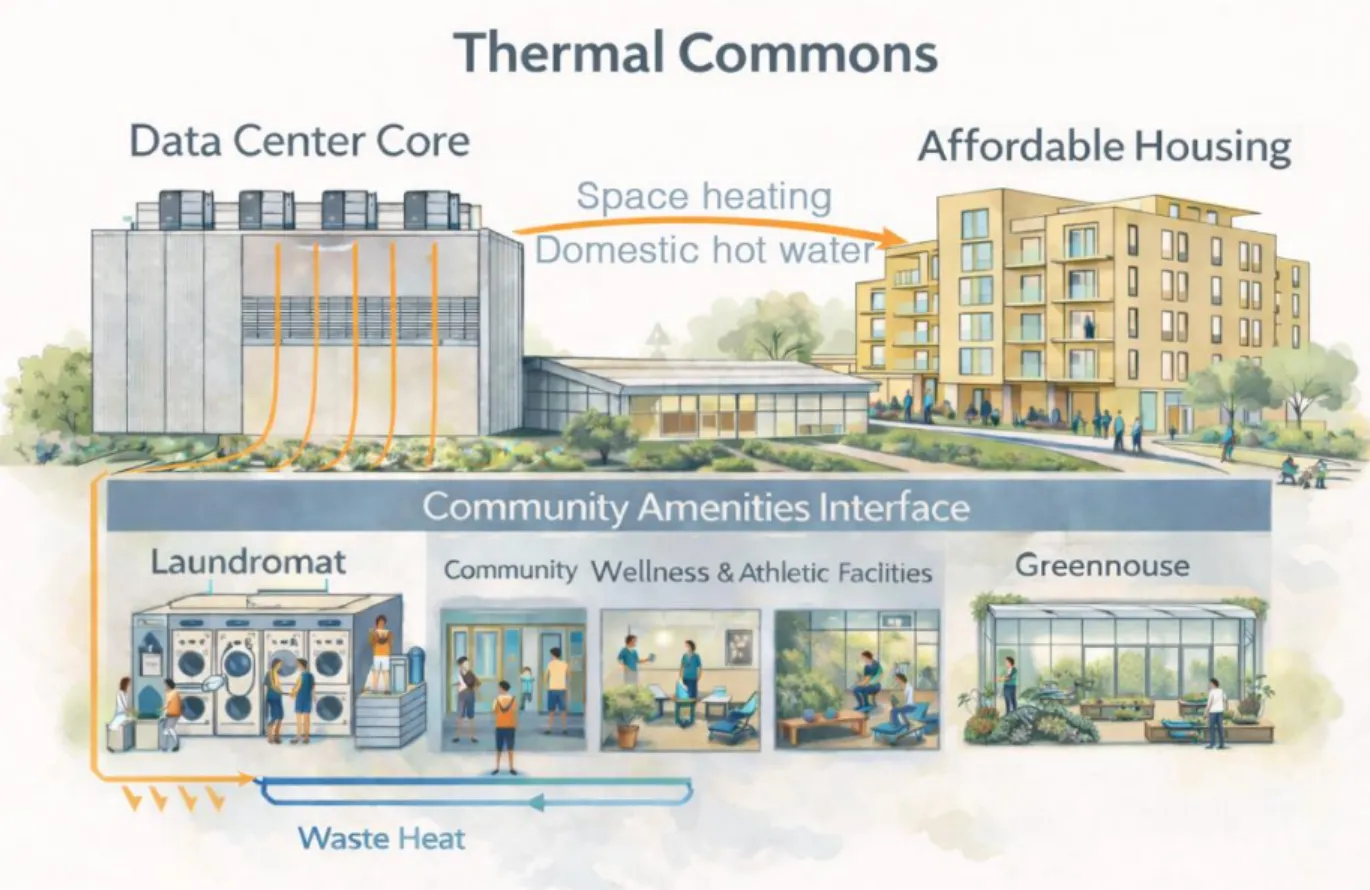
Thermal Commons
Thermal Commons is an early-stage project developing a design framework to co-locate affordable housing with data centers, recovering the thermal energy data centers routinely dissipate for residential and community use (e.g., domestic hot water, heating, shared laundry, greenhouses, and wellness facilities.)
The project sits at the intersection of two pressures rarely treated together. U.S. data center capacity is set to roughly triple by 2035, and community opposition has already delayed or blocked $64 billion in projects. Meanwhile, the country is short 7.1 million affordable rental homes, and low-income households carry roughly three times the energy cost burden of higher-income peers. Working precedents in Stockholm, Helsinki, Odense, Seattle, and a Con Edison–NYCHA pilot in Chelsea confirm the engineering, but each has been bespoke; no replicable framework yet exists for housing developers, data center operators, and municipal planners to systematically identify co-location opportunities.
Thermal Commons aims to fill that gap by matching a data center's thermal profile to feasible community end-uses across climates and governance contexts, organized through a three-layer architecture: a heat-capture-ready data center core, a community amenities interface, and affordable housing connected by shared hydronic infrastructure.
The project is being developed in collaboration with the MIT Building Technology Program and additional scholars across the field. This is a very early stage of the work, and further detail will be shared here as the project progresses.