Toolkit
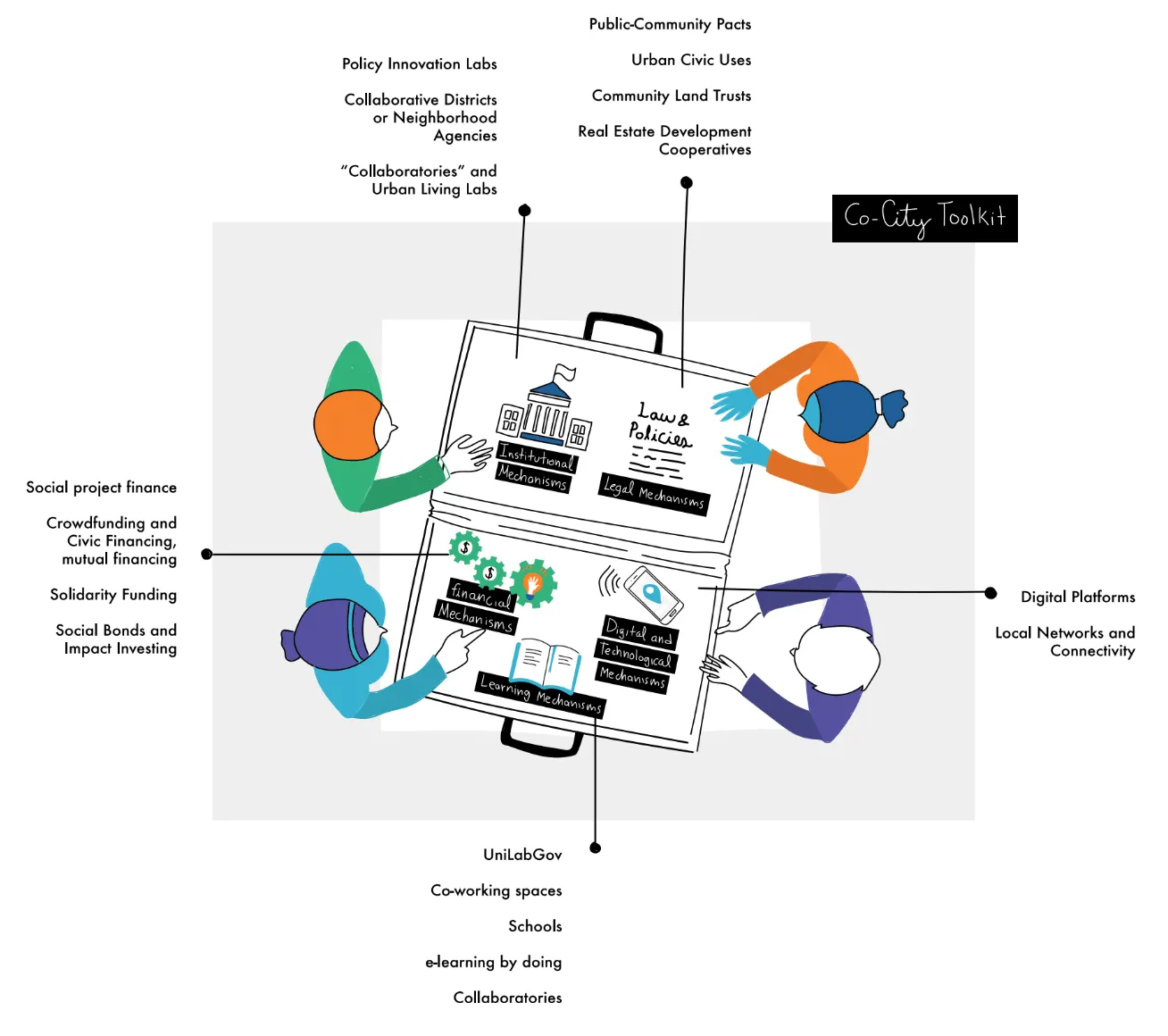
These tools operationalize the Co-City Framework's five principles by providing governance mechanisms that enable co-governance structures to function in practice. The tools fall into four categories—institutional, legal, financial, and digital—and are adapted to local context and community needs
Pathways
The concept goes beyond the idea of a shared resource or community. It refers to the institutional arrangements that enable coordination and collective management of resources, ensuring their accessibility and sustainability for a wide range of users. Our empirical research shows that the institutional ecosystem of a co‑city involves several forms of co‑governance at different scales, such as:
- Policy Innovation Labs
- Collaborative Districts
- Collaborative Working Hubs
- Collaborative Housing
To regulate the process of resource pooling, urban innovators can count on a set of legal instruments, that can be either contractual or institutionalized, which are often represented by partnerships established between at least 3 to as many as 5 different actors. These collaboration mechanisms are designed as to make the resources more available, accessible, and affordable to a broader range of residents:
- Public-Community Pacts
- Urban Civic Uses
- Land Banks (LB)
- Community Land Trust (CLT)
The development of social project financing for collaborative forms of urban infrastructure and urban services is crucial to the success of a polycentric governance system. This kind of financing is an example of the so-called pooling economies, created by attracting funding from different actors or segments of society. They form around the collaborative economy and support the efforts of those city residents who partner with further stakeholders to cooperate for the general interest.
- Crowdfunding and Civic Financing
- Solidarity Funding
- Social Bonds and Social Impact Investing
Technology lies at the heart of the commoning experiences, as digital devices and tools are heavily employed to connect actors and make their collaboration possible. Communication and connectivity stand here for an act of social participation. Reflecting the tech justice principle, digital means can help tackle inequalities and promote a broader access to urban goods and services.
- Digital Platforms
- Local Networks & Connectivity