Harlem E-Project
An Architecture for Secure, Energy-Efficient Community Edge Clouds
Background
The Secure Energy Efficient Community Edge Cloud (SEEC) project was designed to improve access to fast, high-quality digital resources, notably broadband internet, in neighborhoods where such access remains lacking. The project brought together an anchor institution, Silicon Harlem, residents, city officials, and other local stakeholders, researchers, Microsoft, and Cisco, in an iterative process to design and develop a novel, community-based high-speed edge-cloud network. Silicon Harlem hosts over 100 edge-cloud servers, making its Uptown Space the first edge-cloud data center in Upper Manhattan. The data center drives Silicon Harlem closer to offering 5G technology and advances the goal of bridging the digital divide in New York City.
Outcomes & Impacts
SEEC Harlem shows how advanced infrastructure can be deployed to directly address long-standing gaps in digital access. By placing edge cloud servers within Harlem housing and community facilities, the project reduced costs, improved performance, and expanded opportunities for households that had previously relied only on mobile phones.
The initiative also demonstrated how technical innovation can be paired with governance and education to ensure long-term resilience. Legal and institutional frameworks were developed to manage deployment, while participatory assessments engaged residents in shaping priorities. Together, these outcomes illustrate a practical pathway for integrating technology justice into urban planning: infrastructure designed for efficiency and affordability, supported by structures that keep benefits accessible and sustainable. The project's background, methodology, and outcomes are detailed in a peer-reviewed publication.
Project Development
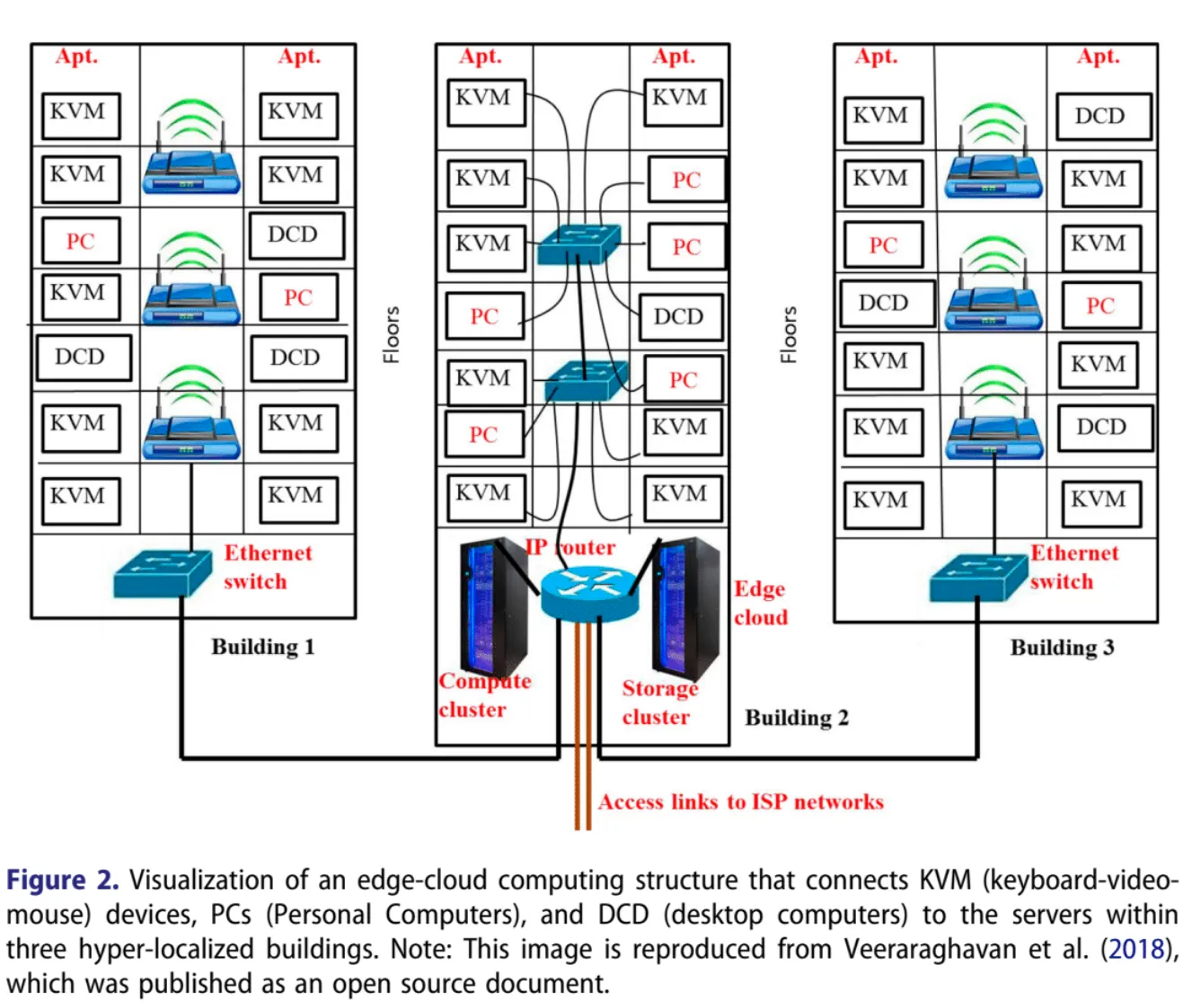
The first track focused on the technical foundation: building a distributed edge cloud cluster capable of supporting low-cost, secure user devices. Instead of relying on expensive laptops or desktops, residents could access computing power through keyboard-video-mouse (KVM) interfaces and other disaggregated devices tethered to local servers.
- Centralized IT management ensured high performance and security.
- Applications such as web browsing, video conferencing, and word processing were hosted directly on the edge cloud.
- Virtual desktops and shared storage created flexible, scalable access for individuals and groups.
This architecture reduced costs, improved energy efficiency, and minimized latency, making advanced computing accessible to households that previously lacked reliable devices.
The second track addressed governance and equity. SEEC Harlem sought to treat broadband and computing infrastructure as a community-constructed commons resource rather than a private commodity.
- Researchers and community leaders developed models for collaborative governance of internet resources.
- Frameworks were designed to equitably distribute benefits and ensure transferability to other underserved communities.
- Legal scholars from Fordham and Georgetown examined outdated regulatory structures and proposed new arrangements to support community ownership.
This track emphasized that technology alone is insufficient; sustainable impact requires inclusive governance and long-term stewardship.
The third track engaged directly with Harlem residents through participatory technology assessments (pTA).
- Community members articulated their highest-priority criteria for edge cloud services and devices.
- Smart community education programs built digital literacy and readiness.
- Engagement activities ensured that the system was not only technically sound but socially responsive.
This participatory approach grounded the project in lived experience, aligning technical design with community needs.